Inherited archive entry · retained from the earlier edition. Its factual, legal and policy claims have not all been reverified for 19 September 2026. Research scope.

The change in May 2021
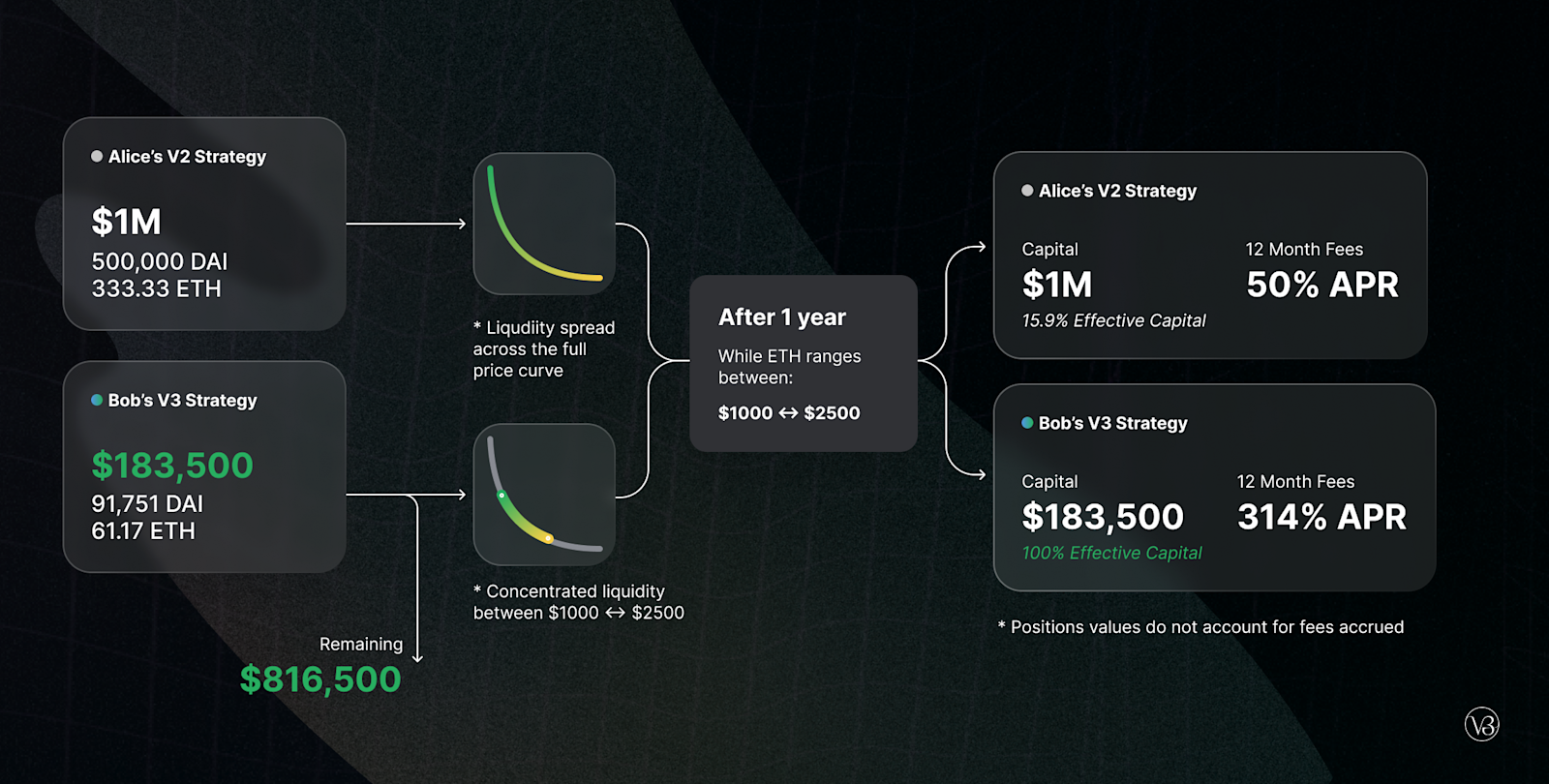
Uniswap Labs announced v3's Ethereum mainnet launch on 5 May 2021. Its central change was to let a liquidity provider choose a price interval in which assets would be available for trades. Earlier versions spread a pool's liquidity across a much wider curve. A narrower interval can offer deeper liquidity near the current price with less capital. That efficiency is real as a design feature, but it is conditional on price remaining in the range.
What a position actually does
Uniswap's developer explanation says a v3 position becomes inactive when market price leaves its specified range and stops earning trading fees while out of range. As trades push price through a position, the inventory changes toward one of the two assets. A provider can choose a wider range to remain active across more prices, but spreads capital more thinly. A tight range can be more efficient near the selected price and demands more attention when that price moves.
This is why 'fees earned' alone is a weak performance measure. A provider must consider the value of the assets they end up holding, the value of simply holding the initial assets, transaction costs of changing positions, and periods when the position earns no fees. A high fee figure can coexist with an unfavorable total outcome. None of that requires a flaw in the pool contract; it follows from the position's economics.
The platform and the person
The original v3 announcement presented examples of capital efficiency and explained that users could combine multiple positions. These examples illustrate a mechanism, not typical realized returns for a reader. The launch post itself noted that audits and a bug bounty did not guarantee every bug had been found. Contract risk and market-making risk should therefore be recorded in separate columns.
The word 'passive' can be misleading here. A position can remain on chain without human action, but its usefulness to traders and its inventory mix change with price. Anyone describing it as a savings account should explain who chooses the range, who monitors it, and what happens outside it. No source here supports a guaranteed yield or an estimate of a reader's future return.
Questions for a position
- What are the lower and upper prices, and why were they chosen?
- Which asset will dominate if price leaves the range on either side?
- Are fees being compared with all costs and the hold-only alternative?
Concentrated liquidity is a clever way to allocate scarce capital to useful prices. It also makes the provider's range choice an active part of the risk.
Sources & reading trail
Launch date, position features and explicit bug-risk boundary.
Source published: 5 May 2021 · Retrieved: 16 September 2026
Active range, fee eligibility and inventory change at range boundaries.
Source published: Not established · Retrieved: 16 September 2026
Original design rationale and illustrative capital-efficiency examples.
Source published: 23 March 2021 · Retrieved: 16 September 2026
Historical sources establish the record; the questions and interpretation are Block Due Diligence’s editorial analysis. This retrospective draft does not imply the site published on the event date.